10 slides, with what the presenter says. Highlighted words are cues: saying them makes something on the slide move.
-
1
Cover
Opens with a fade
Look at this puddle. Where did all that water come from? Today we learn where water goes. Water is always on the move. It goes around and around, and you get to draw it.
-
2
Same water
Enters with a wipe
Look at this glass of water. This water is very, very old. Other people and animals have used it before you. It goes out, and it comes back, over and over.
-
3
Four steps
Enters with a push
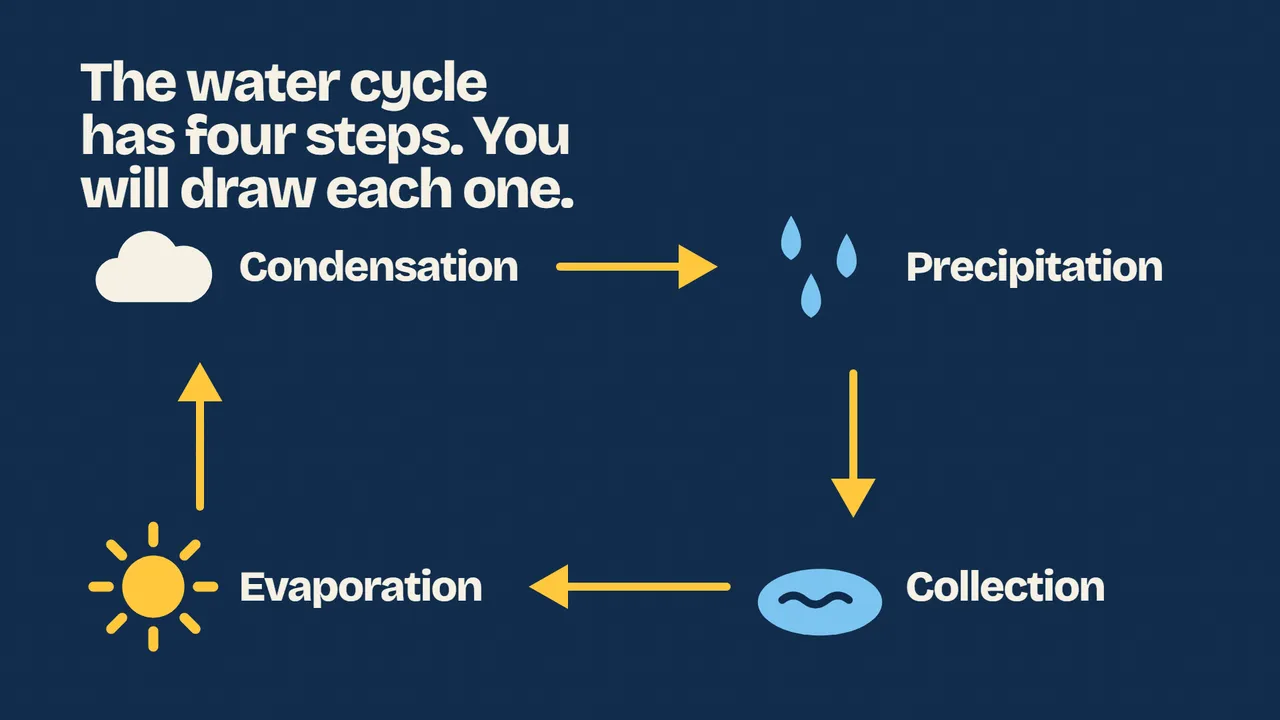
The water cycle has four steps. The first step is evaporation. The second step is condensation. The third step is precipitation. The last step is collection. You will draw every one of them.
-
4
Evaporation
Enters with a slide over
Step one is called evaporation. The sun heats the water in oceans, lakes, rivers and even puddles. The warm water turns into water vapor and floats up into the air. You can't see water vapor, but it is there. Now take your pencil and draw a sun and water.
-
5
Condensation
Enters with a dissolve
Step two is called condensation. The water vapor keeps rising, and high up the air is cooler. The cool vapor turns back into tiny drops of water. The drops gather together and make a cloud. One cloud has billions of tiny drops in it.
-
6
Precipitation
Enters with a split
Step three is called precipitation. The drops in a cloud bump together and grow. When they get big and heavy, they fall to the ground. Most of the time it falls as rain. When it is very cold, it can fall as snow, sleet or hail.
-
7
Collection
Enters with a iris
After the rain falls, the water has to go somewhere. A lot of it runs into oceans, lakes and rivers. Some of it soaks into the ground. We call that groundwater. Some stays as snow high on the mountains, and trees drink water up with their roots.
-
8
Draw it all
Enters with a zoom through
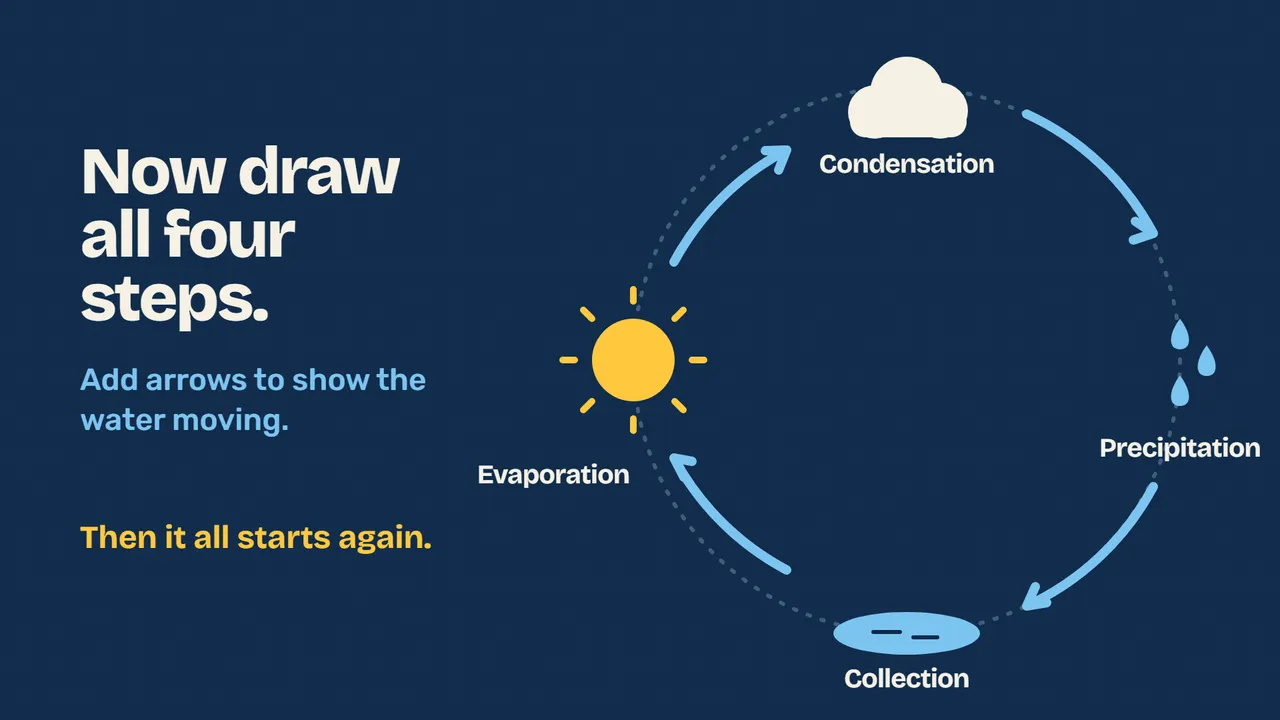
Now it is your turn to draw. Put the sun and the lake at the bottom, the cloud at the top, and the rain on the side. Then draw arrows from one step to the next. The last arrow goes back to the lake, and the whole thing starts again.
-
9
Big idea
Enters with a blinds
So what is the big idea? The same water goes up into the sky. Then it comes down again. Then it goes up again, over and over, forever. Say it with me.
-
10
Notebook question
Enters with a wipe
Here is one last puzzle for you. Yesterday there was a puddle, and today the sun dried it up. Open your notebook and write where that water went. Then write where it might fall next. Use the four steps to help you.