I have to present how photosynthesis works to my 10th grade biology class tomorrow. 8 minutes. Cover light reactions, the Calvin cycle, why it matters for the carbon cycle, and one surprising fact about it.
Companies, people and numbers in the example briefs are made up, unless they’re public facts like history or science.
The look Cue chose
Chlorophyll Poster
Flat fields of leaf green, sun yellow, cream and soil red that change every slide, with huge condensed poster type laid over them.
Type
Anton and Space Grotesk
Colours
leafcreaminkmosssunsoilvein
Motion
Confident and physical. Headlines rise word by word from behind a mask on a strong ease-out, about 0.8s with a 0.07s stagger. Shapes and fields slide in as flat slabs. One slow drift at most (the leaf, the sun). Colour changes on cue words are the signature move: a word floods with sun yellow. Type never wobbles or bounces.
Transitions
Each cut is a colour change. Use wipe (0.7s) when moving to a new field colour, push when the story moves forward a stage (light reactions to Calvin cycle), split for the surprising fact, fade only into the closing slide.
Slide by slide
8 slides, with what the presenter says. Highlighted words are cues: saying them makes something on the slide move.
1
Cover
Opens with a fade
Look at any green leaf outside this window. It is quietly running a factory, and its power source is sunlight. In the next few minutes we will follow that light all the way into sugar. By the end you will be able to explain it in your own words.
2
Two stages
Enters with a push
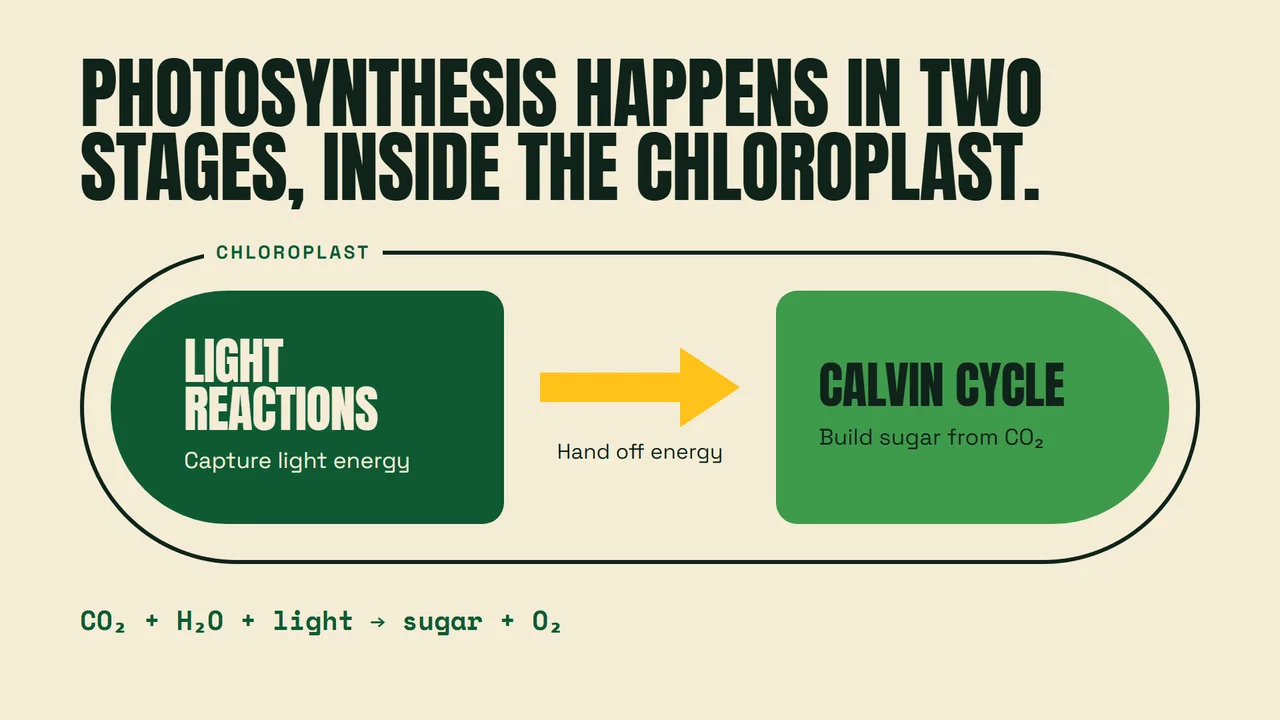
Photosynthesis happens in two stages, and both happen inside the chloroplast. First, the light reactions capture energy from sunlight. Then they hand off that energy, like passing along a charged battery. Finally, the Calvin cycle uses it to build sugar out of carbon dioxide.
3
Light reactions
Enters with a wipe
Here is the first stage up close. Chlorophyll in the thylakoid membranes absorbs light. That energy is used to split water molecules apart. The leftover oxygen floats away, and that is the oxygen you breathe.
4
Charged batteries
Enters with a dissolve
Here is the twist. The light reactions do not make any sugar yet. Instead they charge up two batteries. The first one is ATP. The second one is NADPH. Both of them carry that captured light energy over to the Calvin cycle.
5
Calvin cycle
Enters with a iris
Now the second stage, out in the stroma. The plant pulls in carbon dioxide from the air, and an enzyme called rubisco grabs it. Then the cycle spends the ATP and NADPH, like using up batteries. Out comes sugar, such as glucose. The starting molecule comes back, so the cycle turns again.
6
Carbon cycle
Enters with a slide over
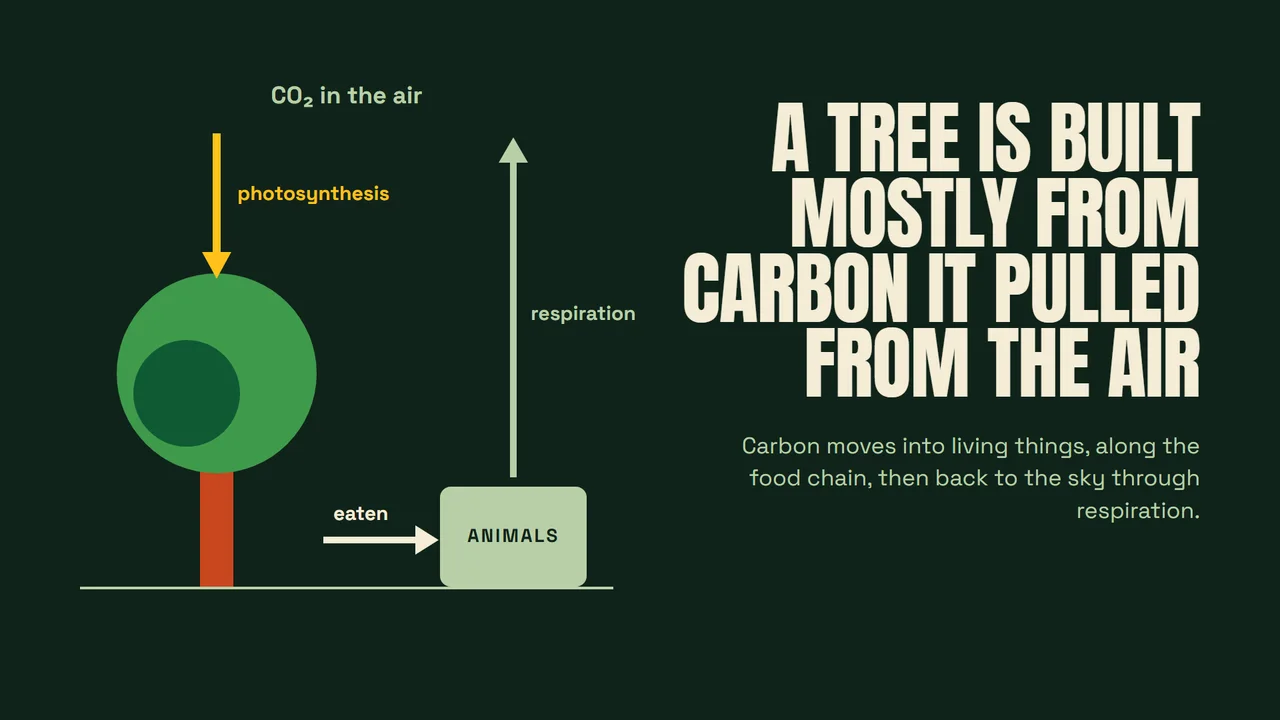
Think about a huge tree. Most of its body is carbon it pulled out of the air. Photosynthesis is the main way carbon gets into living things. Animals eat plants, so that carbon moves along the food chain. Then respiration breathes it back out as carbon dioxide, and the loop is closed.
7
Surprising fact
Enters with a split
When a plant gives off oxygen, where does that oxygen come from? Most people guess carbon dioxide. It is not carbon dioxide. It comes from the water that chlorophyll split apart in the light reactions. Every breath you take started as water inside a leaf.
8
Remember this
Enters with a fade
If you remember one thing, remember this. The light reactions capture light and charge two batteries, ATP and NADPH. The Calvin cycle spends that energy and makes sugar out of carbon dioxide. And that is how carbon from the air enters life on Earth.
Make one like it.
Tell Cue what you’re presenting and who’s listening, or give it an old deck. Early access is open: 100 free credits for everyone who joins before 30 November.