8 slides, with what the presenter says. Highlighted words are cues: saying them makes something on the slide move.
-
1
Cover
Opens with a fade
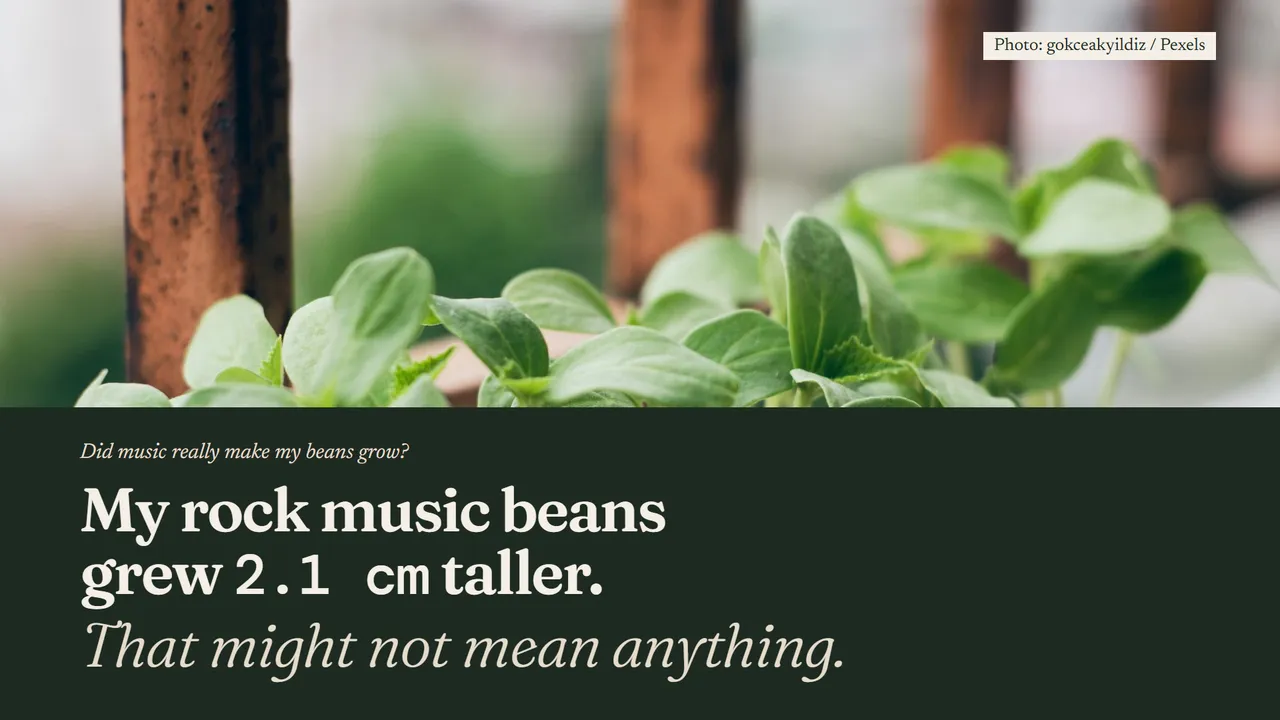
Hi, my project tested if music changes how bean plants grow. My rock music plants grew 2.1 centimeters taller on average. That sounds exciting. But I want to show you why it might not mean what it looks like it means.
-
2
The setup
Enters with a push
First, here is how my experiment worked. I grew bean plants in three groups. One group listened to classical music, one listened to rock music, and one grew in silence as my control group. I let them grow and measured them over four weeks.
-
3
The result
Enters with a wipe
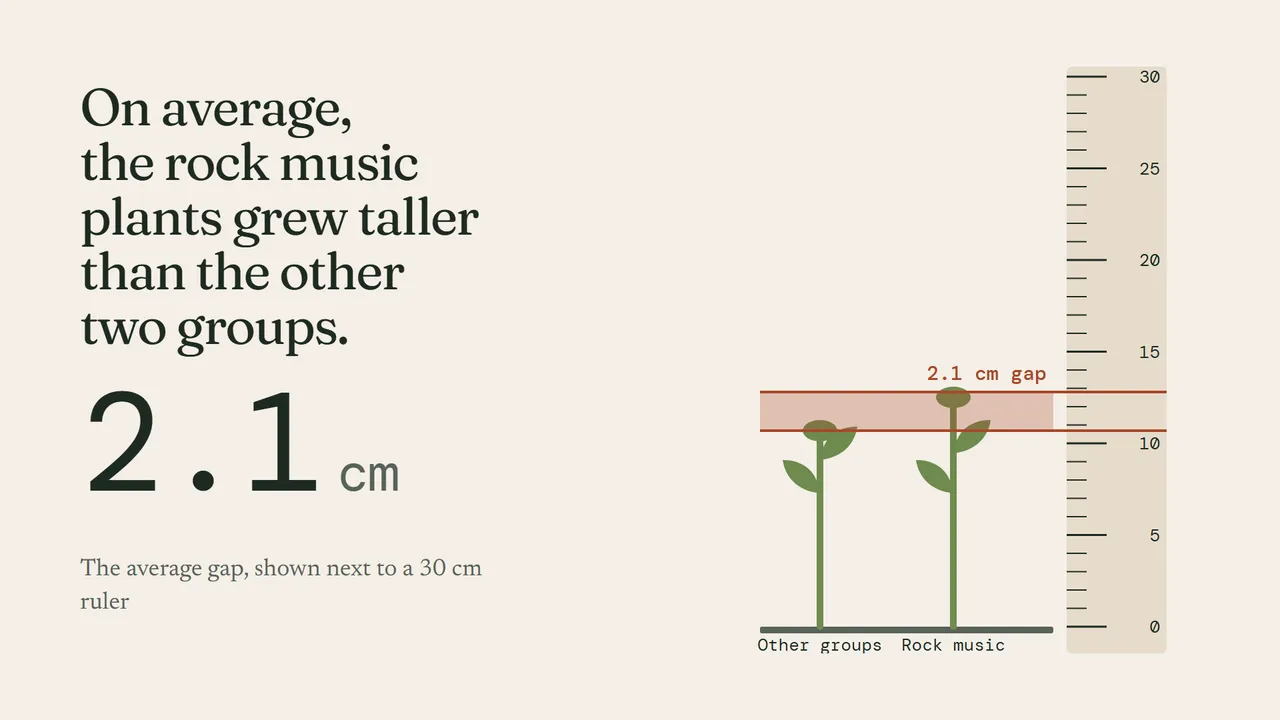
Here is my main result. On average, the rock music plants grew 2.1 centimetres taller than the other two groups. At first that sounded like a big deal to me. But look at how much that is on a ruler. It is a pretty small gap.
-
4
Chance and averages
Enters with a dissolve
Here is what an average can hide. Every plant grows a little differently, even in the same conditions. If just two tall plants shot up, they can pull the whole average up with them. I also never checked if the seedlings were the same height on day one, so some may have started ahead.
-
5
Other conditions
Enters with a slide over
Music was not the only thing that was different. The classical group sat closest to the window, so it may have had more light. The silence group was near the heater, so it was warmer and may have dried out faster. And the rock speaker was loud, so the vibration could have shaken the pots. That would be shaking, not music.
-
6
Measuring and bias
Enters with a split
I measured all the plants myself, with a ruler. But I am not sure I measured the same way every time. Sometimes I may have started at the rim, sometimes at the soil. And every pot had a label that said its group. I wanted rock to win, so that could be bias.
-
7
Difference not cause
Enters with a wipe
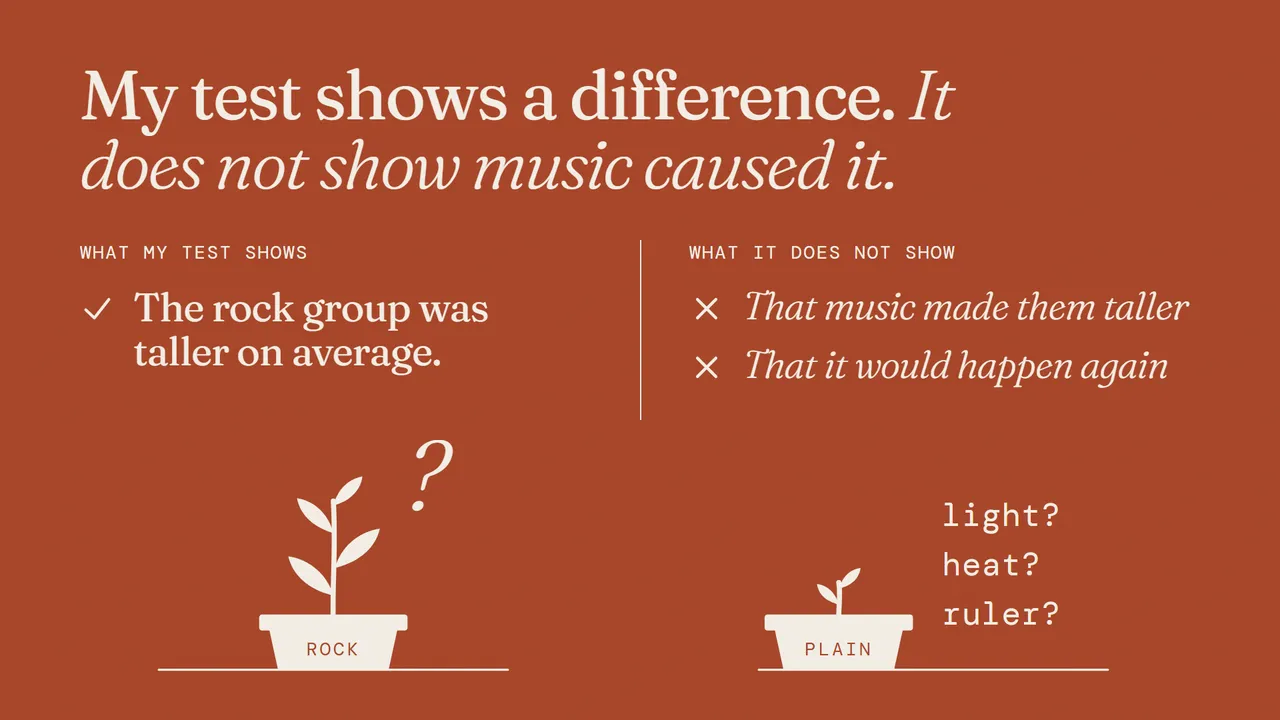
My test did find a real difference. The rock group was taller on average. But that does not prove the music caused it, because something else could have done it, like the light or how I measured. And I only ran the test once, so I don't know if it would happen again.
-
8
A fairer test
Enters with a iris
If I did this project again, I would change six things. I would use more plants, and put them into groups in a random way, like drawing numbers from a hat. All the pots would sit on one table with the same light, water and heat. Someone else would measure them blind, with only a number on each pot. And I would repeat the whole test and show the spread of heights, not just the average.